Published September 17, 2026 06:00AM
How Pro Triathlete Malachi Cashmore Built a Business by Laughing at His Own Mistakes
By embracing disqualifications, race mishaps, and training fails, pro triathlete Malachi Cashmore built a viral social media brand that funds his dream of reaching the top of long-course racing.

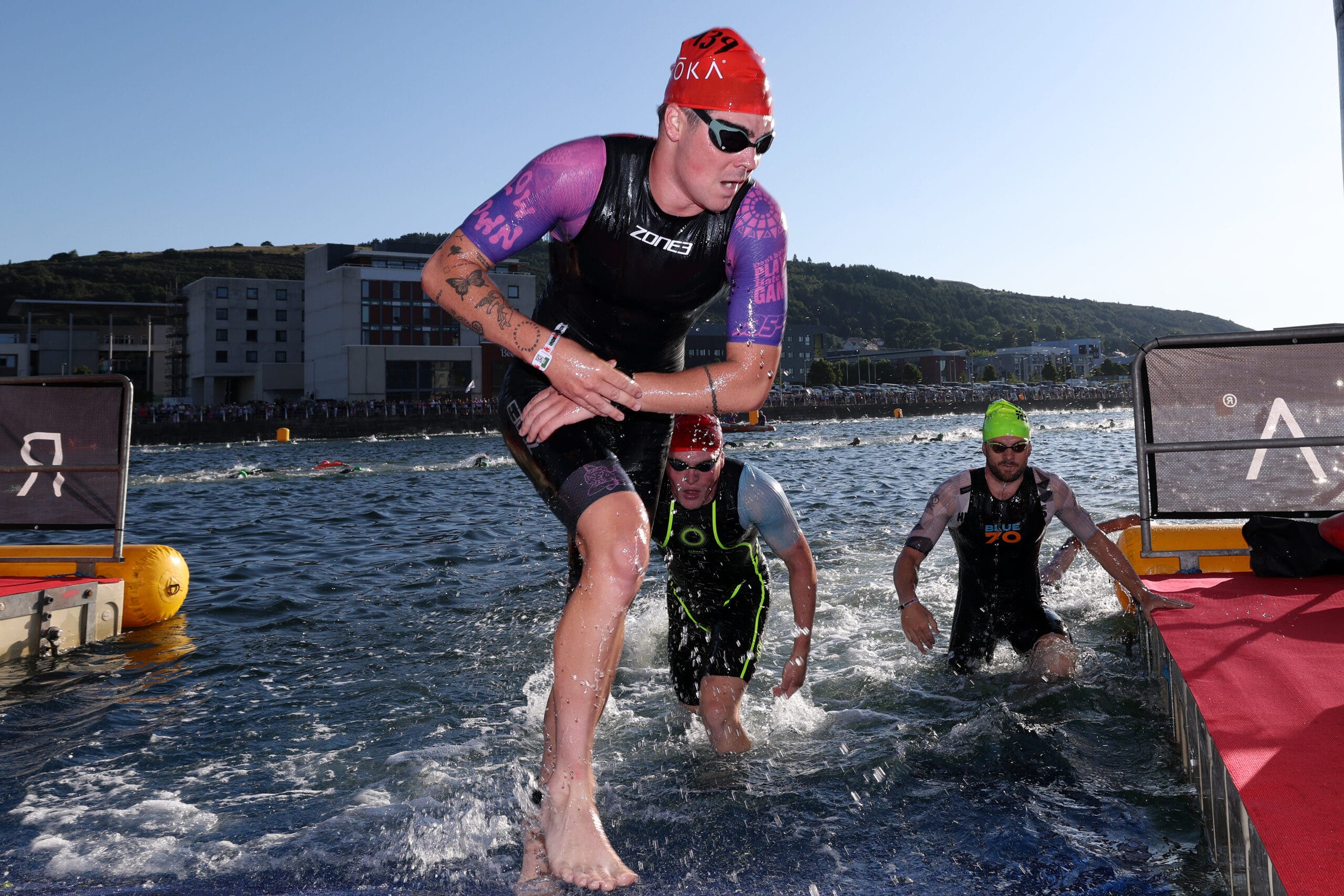
(Photo: Huw Fairclough/Ironman)
One of Malachi Cashmore’s first genuinely viral videos began, appropriately enough, with a disqualification. By then, Cashmore had already made a deliberate decision to take social media seriously. Cashmore had finished his first season racing as a pro, graduated from university, and left his job at a bike shop after cobbling together enough sponsorship to give professional triathlon a proper shot. The problem was that he could already see how difficult it would be to sustain.
“With long-course [triathlon], you kind of need five or 10 years of 30-hour weeks to even get competitive,” he says. “And most people burn out or run out of money. So, I need to make sure I don’t run out of money.”
Getting faster was only part of the challenge. Cashmore needed to make himself valuable enough commercially to buy the time required to see how good he could eventually become.
ADVERTISEMENT
Social media was his answer, with an initial target of 10,000 Instagram followers. Cashmore figured that would generate enough of an audience to put him on the radar of sponsors willing to help fund his racing. While the strategy was simple, it was considerably time-consuming: post a reel every day, even though many took a couple of hours to make. At the start, he wasn’t necessarily trying to land a viral hit. He was just sharing daily because he wanted people to follow the journey and feel as though they knew him.
Then came the disqualification video.
Racing as a professional, Cashmore took what he concedes was a questionable line during the swim. The problem was that most of the pack followed him. Later, on the bike, he received a five-minute drafting penalty.
Cashmore had arrived at the race carrying a niggle and had already decided he probably wouldn’t run. So rather than sit in the penalty tent for five minutes before dropping out anyway, he attacked into T2 and skipped the penalty altogether.
Then something unexpected happened. He started running and kept running. Cashmore completed the entire half marathon, crossed the finish line, and was promptly disqualified for failing to serve the penalty. For most professional triathletes, the episode might have been something to forget as quickly as possible or be embarrassed about. Cashmore turned it into a reel.
ADVERTISEMENT
“On the outside, it looks like, ‘Oh, you idiot,’” he says. But the video took off and brought Cashmore followers. More importantly, it offered an early indication that Cashmore’s different approach to professional athlete content might actually work. It wasn’t another polished race recap; rather, he highlighted his mistake and made himself the joke.
Within two months of committing to post every day, Cashmore had gained more than 10,000 followers. “And now I’m known as more of an influencer than a pro athlete,” he laughs. “So, I guess it went fairly well.”
Eleven months later, the experiment has evolved into a business model. Cashmore, while still trying to discover how good he could become at long-course triathlon, has built an audience by showing the parts of professional sport athletes typically hide. The bad races. Forgotten equipment. Disqualifications. Terrible training sessions. Face-planting in the swim.
“I don’t really mind people laughing at me,” Cashmore shares. “Instagram is just full of everybody sharing their biggest power numbers. So, I try and make an effort of sharing my worst sessions.”
ADVERTISEMENT
This approach has created an unusual contradiction. Cashmore is trying to become a better professional triathlete while discovering that occasionally being a worse one makes for better content.
At Ironman 70.3 Swansea this year, he crashed during what became his best professional performance to date. Even in the middle of the race, he thought about the Instagram value.
“This is perfect,” he remembers thinking. “This is perfect for content.”
Cashmore hasn’t become a successful professional triathlete and then built an audience around that success. He’s doing it the other way around.
ADVERTISEMENT
The path to pro
Cashmore tells Triathlete his athletic backstory with the same self-deprecation that characterizes his Instagram account. He started out as a swimmer and, like plenty of ambitious kids, dreamt of the Olympics. There was just one problem.
“I was so slow at swimming,” he says. “It was so depressing.”
He swam four times a week but watched his friends get faster while he largely stayed the same speed. Away from the pool, he ran a little bit with his parents and spent weekends at skate parks riding BMX bikes, scooters and skateboards. Then his mother bought him a road bike for Christmas.
“That was a big mistake,” he says. “Because now I’ve not had any money at all since. Everything I’ve ever made has gone back into triathlon racing.”
ADVERTISEMENT
Cashmore did his first triathlon at age 16 and spent the next couple of years competing in the UK’s Super Series. By 18, he had reached a blunt conclusion: he wasn’t going to make it in short-course racing. Instead of quitting, he decided to go longer. He figured long-course racing would offer him time to develop and build endurance to compensate for whatever natural talent he believed he lacked.
In 2021, at around 19, he raced his first Ironman 70.3 at Bolton and finished third overall. However, there was no revelation that a career as a professional triathlete was his destiny.
“I just thought I quite liked getting faster at things,” he recalls.
A year later, Cashmore qualified for the age-group world championship in St. George and finished ninth in his age group.
Then he started university and continued racing triathlon, though injuries kept him away from 70.3 racing for a couple of years. Eventually, he earned his professional license in a manner that could now be considered classic Cashmore fashion: he found a loophole.
ADVERTISEMENT
He had spent time guiding a visually-impaired athlete and competed at the World Triathlon Championship Series (WTCS) level in that role. At the time, one of British Triathlon’s professional license criteria required an athlete to have raced at WTCS or World Cup level – but did not explicitly state that the race had to be an individual performance.
“I said, well, I have raced at World Series level,” Cashmore explains. “I got my license through a loophole, which I guess is kind of cool.”
He subsequently met the conventional performance criteria in his first professional race anyway.
University also helped fix one of his biggest triathlon weaknesses. Cashmore chose Cardiff Metropolitan University largely because of its triathlon program. Having considered his swimming hopeless, he left Cardiff, in his words, “as a front-pack swimmer.”
Upon graduation, he wanted to pursue a career in professional triathlon. However, the challenge in his mind was not simply whether he could get fast enough to compete. It was whether he could afford financially enough years of athletic development to find out.
ADVERTISEMENT
Not just race disasters
Over time, his content has become more sophisticated than documenting forgotten equipment or race day calamities. After The Championship in Samorin, Cashmore produced what appeared to be a familiar pro race recap.
“This is how I won my first professional triathlon,” he announces in the reel.
He narrates the day as though everything was going perfectly. He was crushing the race, running toward the biggest result and paycheck of his career, seemingly about to head down the finishing chute to take the tape.
Then an alarm rang. Cashmore woke up. The victory was a dream.
The race itself wasn’t a dream. Cashmore had competed in Samorin and placed 18th. It was the traditional highlight reel turned upside down. Rather than taking an ordinary result and making it look better or offer up excuses, Cashmore created the heroic ending everyone expects to see and then flipped the script.
ADVERTISEMENT
“I think one of the things that I think about when I’m making something is this: “What would everyone else do? Okay, I’ll do the opposite.” He explains.
Cashmore wants to be world-class
One of the dangers of pursuing a content strategy focused on videos about falling over, getting disqualified, and finishing 18th is that people might forget that Cashmore is actually trying to become a world-class triathlete.
One of his favorite reels illustrates his athletic abilities.
At the Outlaw Triathlon in the UK, Cashmore decided to chase £2,000 ($2,696.67) in prize money across three events: a gravel sprint triathlon, a 10K run, and a half-distance triathlon. He won the sprint by a couple of minutes. Next came the 10K, and Cashmore did what he describes as the bare minimum to win.
Because apparently three races wasn’t enough, he also got involved in the children’s race, borrowing a child for the occasion.
ADVERTISEMENT
Then came the half-distance race. With two victories already in his legs, Cashmore won again, taking the course record by just three seconds. Across the three adult events, he scored three wins.
It was funny because Cashmore made it funny. But the weekend revealed that he’s not just an influencer with a pro license. He’s genuinely a competitive athlete who is willing to make himself the punchline.
“I think one of the main things that people really like is that I’ve got a professional license and I’m in professional races starting to win money – but I’m not the best in the world,” he says. “People really respect that I’m trying to be elite and also making fun of myself.”
And in Cashmore’s mind, improving at triathlon doesn’t change the formula.
“As far as I’m concerned, the better I get, the funnier it gets that I am making fun of myself.”
ADVERTISEMENT
The expectation, after all, is that athletes become more guarded and polished as they become more successful. Once again, Cashmore sees the opportunity in doing the opposite of what people expect from pro athletes.
The business of being Malachi
Describing what Cashmore has created as a personal brand still seems to make him uncomfortable.
“I feel weird that you call it a brand,” he tells Triathlete. “I just think of it as me making a reel every day.”
But the range of his activities is increasingly behaving like a brand. Cashmore has made regular appearances on triathlon podcasts. He has a manager. He is making money from YouTube. Followers can even send him money through a button on his account labeled “Buy Haribo.” There is also merchandise.
Cashmore created a T-shirt inspired by the Palace Skateboards logo. Instead of Palace, it read “Malachi Cashmore Triathlon,” along with the phrase: “Dropped as a baby, not dropped since.”
ADVERTISEMENT
Initially, he made one shirt for himself. When followers told him they wanted one too, Cashmore assumed they were joking. He posted a poll. Thousands expressed interest. He still didn’t believe them, so he ordered just 50. They sold out in roughly five minutes. He kept ordering more.
More importantly, the audience Cashmore has cultivated is doing what he had originally hoped for: paying for triathlon.
By his own estimates, around 95% of his income is through sponsorships or what he describes as “influencer deals.” A year earlier, Cashmore had been working in a bike shop and making around $540 per month. He’s now making much more.
“This is not what I expected to be doing in a year,” he reflects. While the financial transformation is important, Cashmore doesn’t confuse the business with the objective.
“The whole point of all the social media is to fund triathlon,” he confirms.
The traditional sequence for professional athletes is usually the opposite: get good, win races, build an audience, find sponsors and convert athletic success into commercial value.
“I’m coming in the back door,” he laughs.
ADVERTISEMENT
Cashmore has built the audience first, creating financial runway to give him enough years to discover how good he can become.
When failure pays
Cashmore’s strategy has also created a question that pro athletes of previous generations have never had to consider. What happens when being good at content and being good at racing reward different things? Cashmore understands the conflict.
“If I do worse in a race, it’s almost better because I’ve got more to talk about and that more people can relate to,” Cashmore admits.
Then he follows that thought to an uncomfortable conclusion.
“I guess it’s probably a bad thing because maybe I’m not so motivated to do really well.”
It was partly a joke, but there is genuine tension there.
A crash gives him a story. A DQ gives him a story. A particularly bad training session gives him a story. Winning cleanly and uneventfully might give him less to work with.
ADVERTISEMENT
So far, the results suggest content creation hasn’t come at the expense of performance. Cashmore is getting faster, and he is starting to earn prize money.
While professional triathlon concentrates much of its sponsorship around a relatively small group of athletes at the top of the rankings table, Cashmore understood that waiting to become one of them wasn’t much of a commercial strategy.
“The sponsor is never going to go for 150th like me,” he says. “So, I’ve got to do something to set myself apart.”
Hence the pink bike. The bikini design race suit. The “eating in the shower” videos. The willingness to finish 18th and make a video pretending he won.
ADVERTISEMENT
Long-term goals for Malachi Cashmore
Cashmore estimates that reaching what he calls “proper world standard level” remains at least two or three years away.
“The goal is definitely to be the best I can be in triathlon,” he remarks. “Otherwise, I’m just an influencer who’s mid-pack, aren’t I?”
Cashmore can make money without winning professional races. He has already attracted sponsors, sold T-shirts and built an audience that is considered commercially valuable, even though he’s far from winning the sport’s biggest events.
There is a certain irony to it. The social media project has worked faster than the triathlon project. Cashmore set out to build enough of an audience to sustain a professional career. Less than a year later, he’s reaping the rewards. Becoming the athlete he wants to be will take longer.
ADVERTISEMENT
When Cashmore imagines looking back in five years from now, none of the follower counts, viral videos, or sponsorship deals are what he thinks about.
“In five years, I won’t really remember, ‘Oh Shokz headphones paid me for a reel’,” he says. “It’ll be, ‘Did you actually win anything?’ Because that was the whole point.”
For now, Cashmore has built a business that allows him to find out. And if things don’t go to plan, at least he knows what to do with the footage.